




Cloud computing
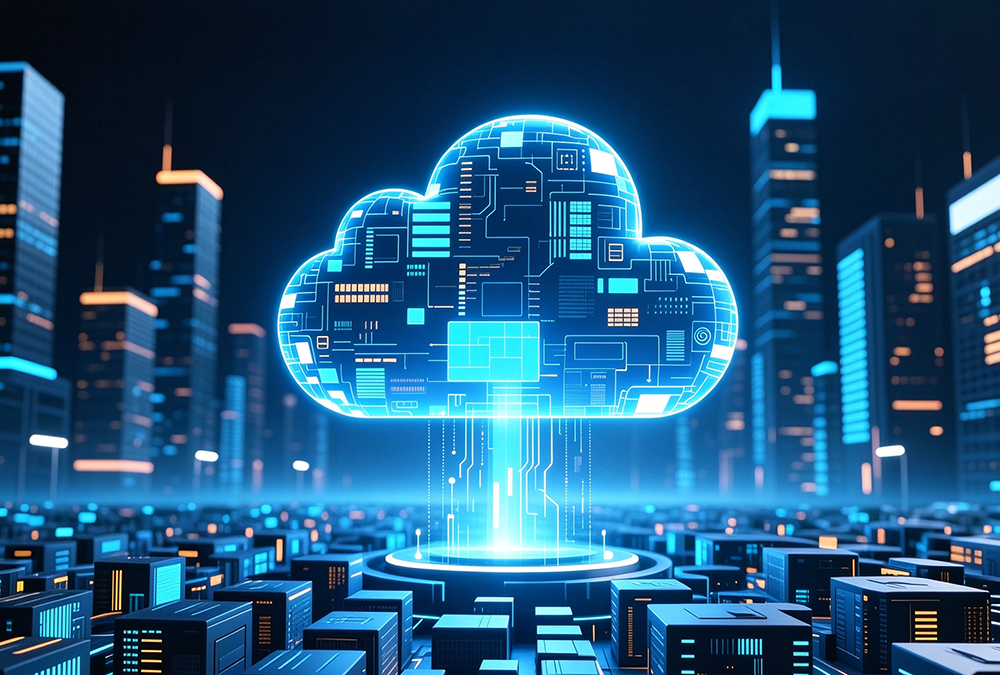
Cloud computing is a business computing model that distributes computing tasks across a resource pool consisting of a large number of computers, enabling users to obtain computing power, storage space, and information services on demand.
This type of resource pool is called "cloud". "Cloud" refers to a set of virtual computing resources that can be self-maintained and managed, typically consisting of large server clusters including computing servers, storage servers, and broadband resources. Cloud computing centralizes computing resources and achieves automatic management through specialized software, without the need for human intervention. Users can dynamically apply for partial resources to support the operation of various applications, without having to worry about tedious details, allowing them to focus more on their own business, which is conducive to improving efficiency, reducing costs, and facilitating technological innovation. The core concept of cloud computing is the resource pool, which is very similar to the concept of grid computing pool (Computing Pool) proposed as early as 2002. Grid computing pool virtualizes computing and storage resources into a collection that can be arbitrarily combined and allocated. The scale of the pool can be dynamically expanded, and the processing power allocated to users can be dynamically recycled and reused. This model can greatly improve resource utilization and enhance the service quality of the platform.
It is called "cloud" because it shares some characteristics with real-life clouds in certain aspects: clouds are generally large; their scale can expand and contract dynamically, and their boundaries are blurred; clouds drift in the sky, and it is neither possible nor necessary to determine their specific location, yet they indeed exist somewhere. It is also called "cloud" because Amazon, one of the pioneers of cloud computing, gave a new name, "Elastic Computing Cloud," to what was once known as grid computing, and achieved commercial success with it.
Some people liken this model to a shift from a single generator power supply to a centralized power supply from a power plant. It implies that computing power can also be circulated as a commodity, just like gas, water, and electricity, with convenient access and low cost. The biggest difference lies in the fact that it is transmitted through the Internet.
Cloud computing is the evolution of parallel computing, distributed computing, and grid computing, or the commercial implementation of these computing science concepts. It is the result of the mixed evolution and leapfrogging of concepts such as virtualization, utility computing, Infrastructure as a Service (IaaS), Platform as a Service (PaaS), and Software as a Service (SaaS).
From the current research perspective, cloud computing exhibits the following characteristics.
(1) Ultra-large scale. The "cloud" boasts considerable scale, with Google Cloud Computing already possessing over 1 million servers, and companies like Amazon, IBM, Microsoft, and Yahoo each having hundreds of thousands of servers in their "clouds". The "cloud" can endow users with unprecedented computing power.
(2) Virtualization. Cloud computing enables users to access services from any location and using various devices. The requested resources come from the "cloud" rather than a fixed, tangible entity. Applications run somewhere in the "cloud", but in reality, users do not need to know the specific location where the application is running. All they need is a laptop or a PDA to obtain various highly capable services through network services.
(3) High reliability. The "cloud" employs measures such as data replication for fault tolerance and isomorphic and interchangeable computing nodes to ensure high reliability of services. Using cloud computing is more reliable than using local computers.
(4) Versatility. Cloud computing is not targeted at specific applications. With the support of the "cloud", a myriad of applications can be constructed, and the same "cloud" can support the operation of different applications simultaneously.
(5) High scalability. The scale of the "cloud" can be dynamically scaled to meet the needs of application and user growth.
(6) On-demand service. "Cloud" is a vast resource pool, where users purchase on demand and pay for services like water, electricity, and gas.
(7) Extremely cost-effective. The special fault-tolerant measures of the "cloud" enable the use of extremely inexpensive nodes to form the cloud; the automated management of the "cloud" significantly reduces data center management costs; the public and universal nature of the "cloud" greatly enhances resource utilization; and the "cloud" facilities can be built in areas with abundant electric power resources, thereby significantly reducing energy costs. Therefore, the "cloud" offers an unprecedented cost-performance ratio. As a result, users can fully enjoy the low-cost advantage of the "cloud". When needed, data processing tasks that previously required tens of thousands of dollars and months of time can now be completed in just a few hundred dollars and a day.
< PREV: None
NEXT >: None
Related Cases
MORE >-
![field.arcurl}]()
Cloud computing
Cloud computing is a business computing model that distributes computing tasks across a resource pool consisting of a large number of computers, enabling users ...
-
![field.arcurl}]()
Intelligent security surv
In recent years, with the increase in personnel mobility, economic development, and improvement in people's quality of life, general buildings have been unable ...
-
![field.arcurl}]()
Internet of Things (IoT)
The Internet of Things (IoT) is built upon the foundation of the computer internet, utilizing technologies such as RFID and w